
60-day returns • free shipping on USA orders $129+
Simply Charlotte Mason Curriculum Overview
A complete Charlotte Mason curriculum your whole family will enjoy!
Homeschool your children the Charlotte Mason way with confidence! With the Simply Charlotte Mason curriculum, you’ll enjoy beautiful lessons that instill a love of learning. Your whole family is together for as many subjects as possible as you learn from a wonderful mix of modern and classic books. It’s a thorough and enjoyable education from a Christian worldview.
The Simply Charlotte Mason curriculum is divided into three parts: History Studies, Enrichment Studies, and Individual Student Lessons.
History Studies (family together)
The History Studies give you day-by-day plans that guide your whole family through a six-year study of the pageant of history. Bible history is studied alongside history of the world. Geography is added once a week as you learn about regions through history. And Bible studies grow your students’ ability to understand God’s Word.
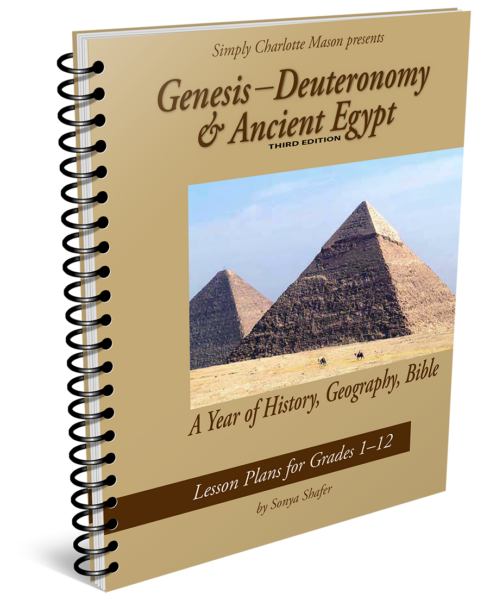
Genesis Through Deuteronomy & Ancient Egypt
- Bible History: Creation through Moses
- Ancient History: Ancient Egypt
- Geography: Africa
- Bible: Genesis through Deuteronomy
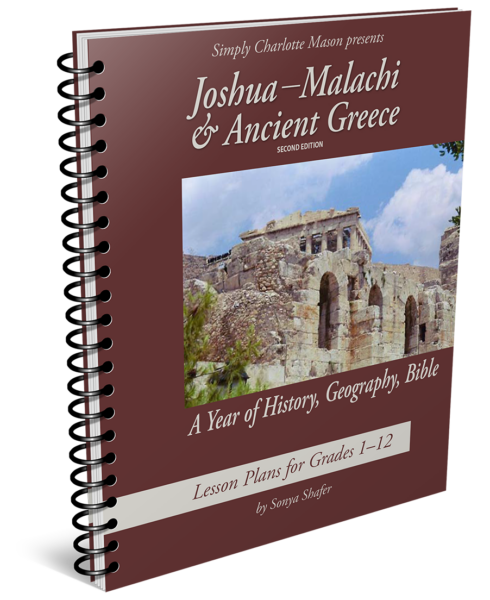
Joshua through Malachi & Ancient Greece
- Bible History: Joshua through Nehemiah
- Ancient History: Ancient Greece
- Geography: Middle East
- Bible: Joshua through Malachi
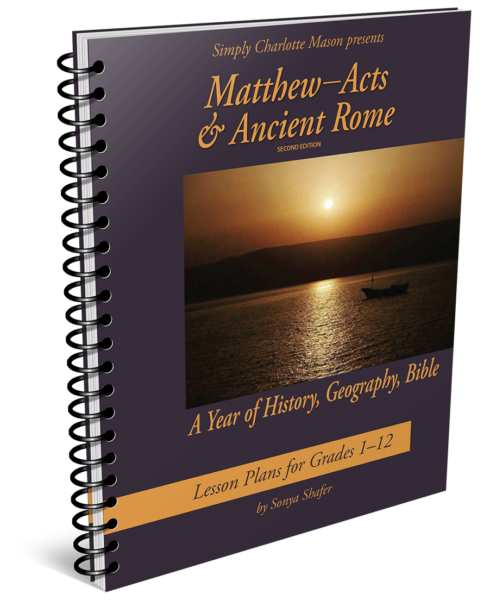
Matthew through Acts & Ancient Rome
- Bible History: Life of Christ through Paul
- Ancient History: Ancient Rome
- Geography: Europe
- Bible: Matthew through Acts
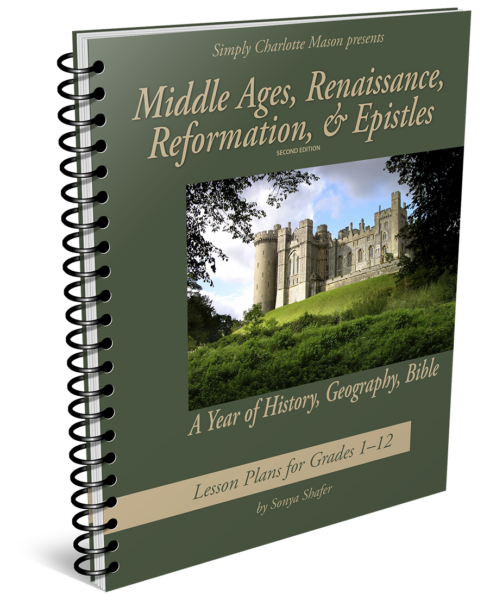
Middle Ages, Renaissance, Reformation & Epistles
- World History: Middle Ages, Renaissance
- Church History: Reformation
- Geography: South and Central America, Australia
- Bible: James, Galatians, 1 Thessalonians, 2 Thessalonians, 1 Corinthians, 2 Corinthians
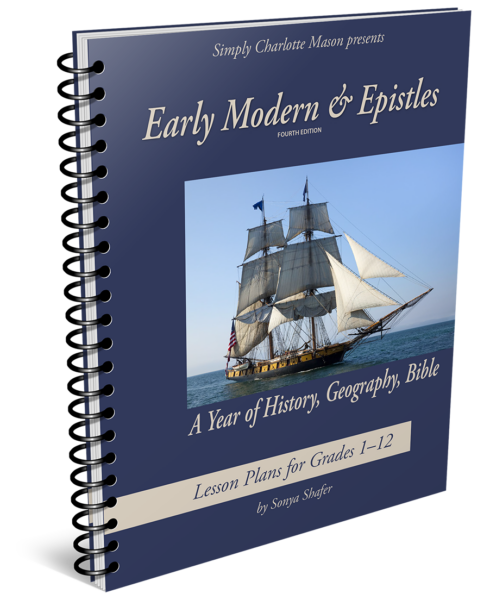
Early Modern & Epistles
- World History: Early Modern
- American History: Colonial America through the Alamo
- Geography: North America
- Bible: Ephesians, Philippians, Colossians, Philemon, Hebrews, 1 Timothy, 2 Timothy, Titus
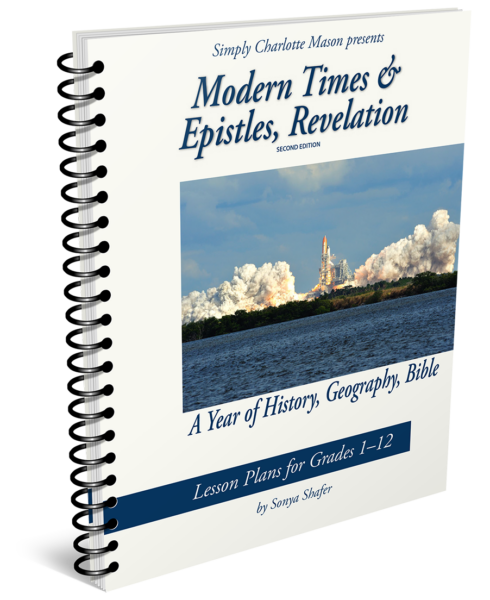
Modern Times & Epistles, Revelation
- World History: Modern Times
- American History: Civil War through the Information Age
- Geography: Asia
- Bible: 1 Peter, 2 Peter; 1 John, 2 John, 3 John, Jude, Revelation
Begin anywhere in the series and continue forward chronologically. You can start at the very beginning, or if you’re coming to Simply Charlotte Mason from another history curriculum just pick up where you left off.
History Curriculum Overview
| History Time Period → Subject ↓ | Genesis through Deuteronomy & Ancient Egypt | Joshua through Malachi & Ancient Greece | Matthew through Act & Ancient Rome | Middle Ages, Renaissance, Reformation & Epistles | Early Modern & Epistles | Modern Times & Epistles, Revelation |
| History | Ancient History: Ancient Egypt Bible History: Creation through Moses | Ancient History: Ancient Greece Bible History: Joshua through Nehemiah | Ancient History: Ancient Rome Bible History: Life of Christ through Paul | World History: Middle Ages, Renaissance Church History: Reformation | World History: Early Modern American History: Colonial America through the Alamo | World History: Modern Times American History: Civil War through the Information Age |
| Geography | Africa | Middle East | Europe | South and Central America, Australia | North America | Asia |
| Bible | Genesis—Deuteronomy | Joshua–Malachi | Matthew–Acts | James, Galatians, 1 & 2 Thessalonians, 1 & 2 Corinthians | Ephesians, Philippians, Colossians, Philemon, Hebrews, 1 & 2 Timothy, Titus | 1 & 2 Peter; 1, 2, & 3 John; Jude; Revelation |
Enrichment Studies (family together)
Enrichment Studies are the subjects that bring interest to your homeschool day! Sprinkle these subjects throughout your week to give yourself a change of pace and introduce your children to a wide variety of ideas.
Lesson plans are available for three complete school years of Enrichment Studies. Pick any of the three and enjoy!
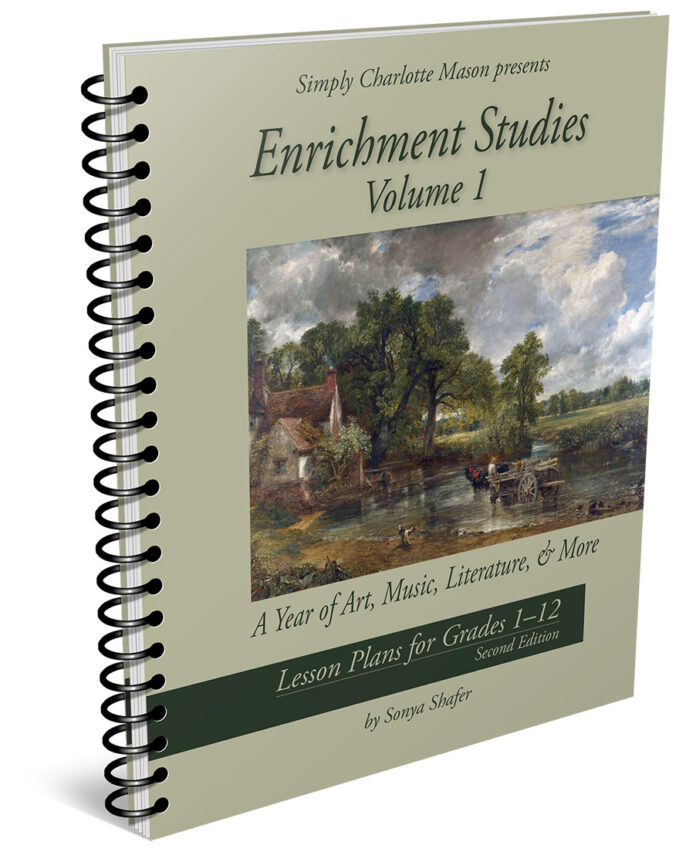
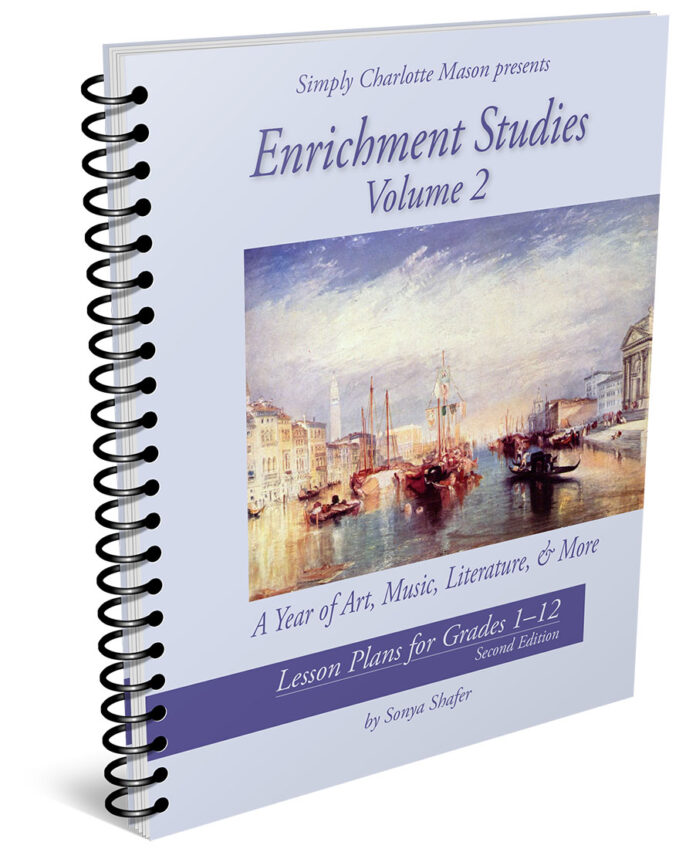
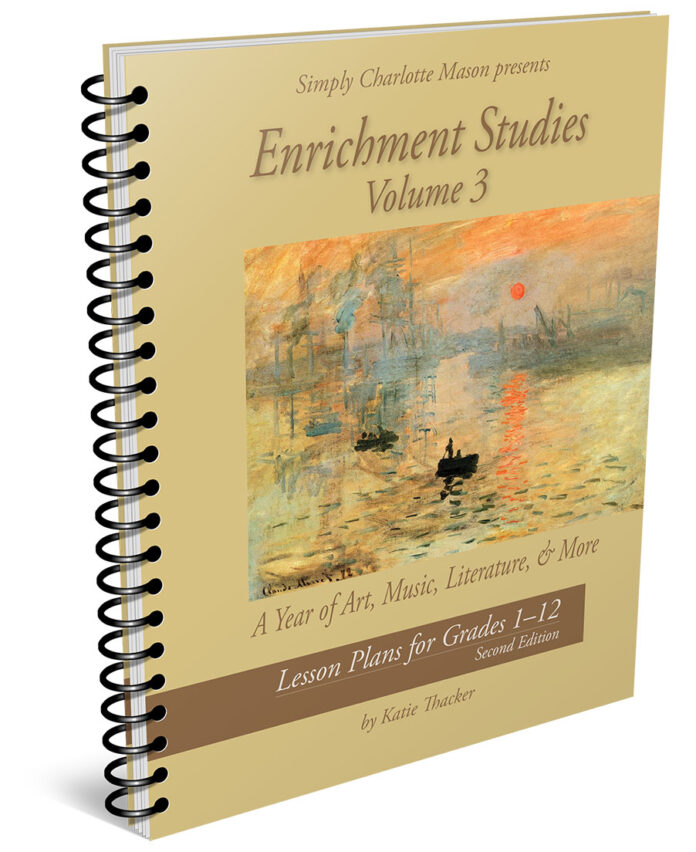
Enrichment Studies Overview
Each of the Enrichment Studies lesson plans provides you complete book lists and daily lessons for these enjoyable subjects.
| Scripture Memory | One verse pack per year |
| Picture Study | Three artists per year |
| Music Study | Three composers per year |
| Hymn Study | Six hymns per year |
| Handicrafts & Art | Three craft/art media per year |
| Shakespeare | One play per year (grades 2–12) |
| Foreign Language | One conversational language for the whole family; older students may add a study of Latin |
| Nature Study | Outdoor time and nature notebooks once a week |
| Poetry | One poet per year |
| Literature | Family read-alouds; older students may have additional independent reading |
| Habits & Personal Development | Habit-training; older students read and discuss additional books with parents |
Individual Student Lessons
Math, science, and language arts should be taught one-on-one at each student’s individual pace. Below you will find recommendations for what to cover in each grade. Click any grade to see an overview of what to teach for that grade, a daily schedule chart, and list of needed resources.
Individual Student Lessons Overview
| Subject | Preschool | Kindergarten | Grade 1 | Grade 2 | Grade 3 | Grade 4 | Grade 5 | Grade 6 | Grade 7 | Grade 8 | Grade 9 | Grade 10 | Grade 11 | Grade 12 |
|---|---|---|---|---|---|---|---|---|---|---|---|---|---|---|
| Science | Informal outdoor play | Informal outdoor play | Nature Study Living Science Course | Nature Study Living Science Course | Nature Study Living Science Course | Nature Study Living Science Course | Nature Study Living Science Course | Nature Study Living Science Course | Nature Study General Science Course | Nature Study Earth Science Course | Nature Study Biology Course | Nature Study Chemistry Course | Nature Study Physics Course or elective | Nature Study Advanced Science (elective) |
| Reading | Letter sounds | Word-building | Learn to read | Reading practice | Reading practice | Read some of own school books | Read more of own school books | Read more of own school books | Read more of own school books | Read more of own school books | Read most of own school books | Read most of own school books | Read own school books | Read own school books |
| Handwriting | Drawing | Letter formation practice | Learn to print Print copywork | Print copywork Learn cursive | Print or cursive transcription | Print or cursive in school assignments Learn typing | Print or cursive in school assignments Practice typing | Print, cursive, or typing in school assignments Book of Mottoes/Commonplace Book | Print, cursive, or typing in school assignments Book of Mottoes/Commonplace Book | Print, cursive, or typing in school assignments Book of Mottoes/Commonplace Book | Print, cursive, or typing in school assignments Book of Mottoes/Commonplace Book | Print, cursive, or typing in school assignments Book of Mottoes/Commonplace Book | Print, cursive, or typing in school assignments Book of Mottoes/Commonplace Book | Print, cursive, or typing in school assignments Book of Mottoes/Commonplace Book |
| Spelling | Incorporated into reading and handwriting lessons | Incorporated into reading and handwriting lessons | Write some words from transcription exercises by memory | Studied Dictation, up to 1–2 sentences | Studied Dictation, up to 2–3 sentences | Studied Dictation, up to 3–4 sentences | Studied Dictations, up to 1 paragraph | Studied Dictations, up to 1 paragraph | Studied Dictations, up to 2 paragraph | Studied Dictations, up to 2 paragraph | Studied Dictations, up to 3 paragraph | Studied Dictations, up to 3 paragraph | ||
| English Grammar & Usage | Hear good use of language in books read aloud | Hear good use of language in books read aloud | Guided discovery of English usage Capitalization Punctuation | English usage Capitalization Punctuation Parts of speech | English usage Capitalization Punctuation Parts of speech | English usage Capitalization Punctuation Parts of speech | English usage Capitalization Punctuation Parts of speech Sentence analysis | English usage Capitalization Punctuation Parts of speech Sentence analysis | English usage Capitalization Punctuation Parts of speech Sentence analysis Word studies | English usage Capitalization Punctuation Parts of speech Sentence analysis Word studies | English usage Capitalization Punctuation Parts of speech Sentence analysis Word studies | English usage Capitalization Punctuation Parts of speech Sentence analysis Word studies | ||
| Math | Informal math activities | Informal math activities | Elementary Arithmetic | Elementary Arithmetic | Elementary Arithmetic | Elementary Arithmetic | Elementary Arithmetic Practical Geometry | Elementary Arithmetic Practical Geometry | Pre-Algebra | Algebra I | Geometry | Algebra II | Consumer Math or Pre-calculus | Calculus (elective) |
| Composition | Oral narration (narrative style) | Oral narration (narrative style) | Oral narration (narrative style) | Oral narration 1 written narration per week (narrative or expository style) | Oral narration 2 written narrations per week (narrative or expository style) | Oral narration 2 written narrations per week (narrative or expository style) | Oral narration 3 written narrations per week (narrative, expository, or descriptive style) | Oral narration 3 written narrations per week (narrative, expository, or descriptive style) | Oral narration 4 written narrations per week (narrative, expository, or descriptive style) Composition lessons | Oral narration 4 written narrations per week (narrative, expository, or descriptive style) Composition lessons | Oral narration 5 written narrations per week (narrative, expository, descriptive, or persuasive style) Composition lessons | Oral narration 5 written narrations per week (narrative, expository, descriptive, or persuasive style) Composition lessons |
Putting Together Your Plan
It’s simple to build your family’s school year with the Simply Charlotte Mason lesson plans.
Step 1: Select Your Plans
Choose one each from the two family lesson plan series to customize your plan. You will need
- one History time period;
- one Enrichment plan.
Plus the resources listed for Individual Student Lessons for each grade you will be teaching this year.
Need Help Planning?
Book a free consultation call! Our friendly team of homeschool moms is knowledgeable about the Charlotte Mason approach and eager to help you succeed. They’ll help you decide what will work best for your family!
Step 2: Gather Your Resources
Use the complete book list in the front of each lesson plan guide to gather the books you need for the school year. To help you save time and money, each guide gives you a breakdown of which books are likely to be available at your library and which ones can be downloaded for free.
Step 3: Enjoy Your Homeschool year!
Simply complete one lesson from each guide per day. You and your family will enjoy a wide variety of subjects, form heart connections, and experience true learning with the wonderful Charlotte Mason approach to homeschooling.