
Free shipping on USA orders over $129!

During the past few weeks we have been sharing that there is more to nature study than just spending time outside. The well-rounded science education that Charlotte Mason described for her students included outdoor field work, living science books, natural object lessons, and special nature projects—all documented in each child’s personal nature notebook.
Today we want to zero-in on special projects. Charlotte mentioned at least five great nature projects that you and your children can do together to learn more about God’s creation. Some of these you might remember from your own childhood days, hopefully with fondness. And now it’s your turn to pass along these memorable and valuable experiences to your children. Here are five nature projects that Charlotte recommended doing.
Ant Farm
Charlotte described how to make a glass container to hold the ant farm in Home Education, pages 57 and 58. You could follow her instructions to create your own habitat for ants, or these days you can also order a ready-made ant farm on the Internet or even get a fancy version with gel and LED lights. (I guess that one is a high-tech ant farm.) Either way your children will be able to observe the habits/behaviors of ants.
Caterpillar to Butterfly
Watching a caterpillar turn into a butterfly is a wonderful experience that every child should have the privilege of observing. Charlotte talked about this nature project in Home Education, page 60.
You can do this nature project with something as simple as a glass jar or as elaborate as a Butterfly Pavilion. Look carefully for caterpillars on plants. When you find one, carefully place it in a container. Also put in some of the leaves from the plant on which you found it. If you are using a jar, secure some netting or mesh screen over the opening. (Covering the mouth of the jar with that type of material is preferred over punching holes in the jar lid, because those sharp edges can sometimes injure the caterpillar.) Keep the caterpillar supplied with fresh leaves from the plant on which you found it. The caterpillar will eat them. Eventually, the caterpillar will be ready to make a cocoon or chrysalis. Watch the cocoon or chrysalis each day, so you will notice when the moth or butterfly emerges.
Pressing Wild Flowers
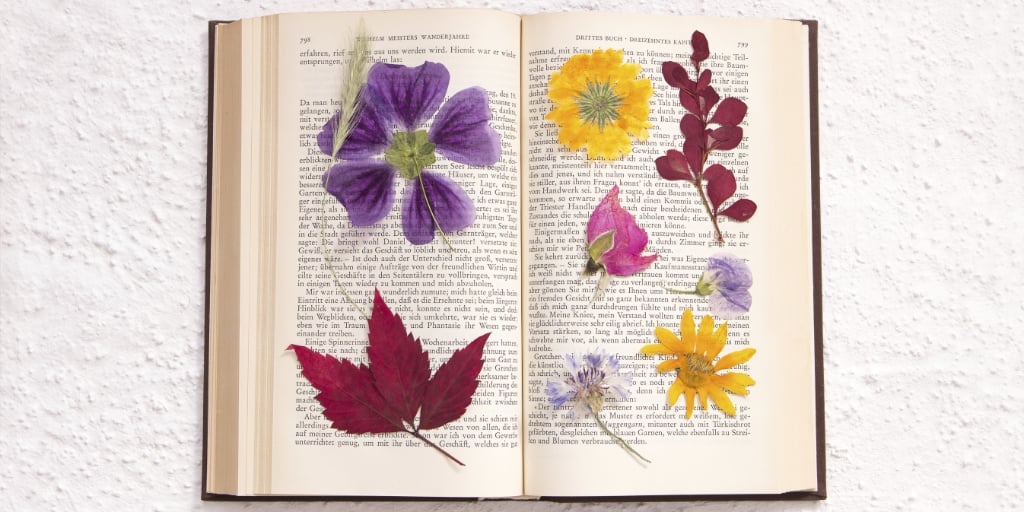
Collecting and pressing wild flowers is another great nature project that you and your children can do together, whether you use heavy books or a ready-made Plant Press.
Charlotte said:
“To make collections of leaves and flowers, pressed and mounted, and arranged according to their form, affords much pleasure, and, what is better, valuable training in the noticing of differences and resemblances” (Home Education, pp. 63, 64).
Children can look for plants with heart-shaped or spoon-shaped leaves, with whole or divided leaves; leaves with criss-cross veins and leaves with straight veins; bell-shaped flowers and cross-shaped flowers; flowers with three petals, with four, with five; etc.
Tadpoles to Frogs
You can also scoop up tadpoles in a nearby lake or pond and watch them turn into frogs. (Note: Be sure to research conservation laws in your area. Taking tadpoles from a private body of water is usually okay, but check local/state/federal laws to see if it is legal to take tadpoles from a public waterway.)
“Surely there is a pond within reach—by road or rail—where tadpoles may be caught, and carried home in a bottle, fed, and watched through all their changes—fins disappearing, tails getting shorter and shorter, until at last there is no tail at all, and a pretty pert little frog looks you in the face” (Home Education, p. 56).
If you don’t live near a pond, Frog Hatchery Kits are available, complete with tadpoles.
Bird Stalking
Rather than finding and potentially disturbing birds’ nests, Charlotte recommended something less intrusive, called “bird stalking.”
“Bird ‘stalking,’ to adapt a name, is a great deal more exciting and delightful than bird’s-nesting, and we get our joy at no cost of pain to other living things. All the skill of a good scout comes into play. Think, how exciting to creep noiselessly as shadows behind river-side bushes on hands and knees without disturbing a twig or a pebble till you get within a yard of a pair of sandpipers, and then, lying low, to watch their dainty little runs, pretty tricks of head and tail, and to hear the music of their call. And here comes in the real joy of bird-stalking. If in the winter months the children have become fairly familiar with the notes of our resident birds, they will be able in the early summer to ‘stalk’ to some purpose. The notes and songs in June are bewildering, but the plan is to single out those you are quite sure of, and then follow up the others. The key to a knowledge of birds is knowledge of their notes, and the only way to get this is to follow any note of which you are not sure. The joy of tracking a song or note to its source is the joy of a ‘find,’ a possession for life” (Home Education, pp. 89, 90).
A Few More Nature Project Ideas
And here are a few more wonderful ways to encourage your children to spend lots of focused, personal time with nature.
- Planning, Planting, and Tending a Garden—Whether you have the room and ability to till some ground or just use a container on a windowsill or a porch, you can give your child the opportunity to watch flowers, vegetables, herbs, or even fruit trees grow. And if it is your child’s own garden, he can have the added joy of harvesting and eating the herbs or produce when it is ready or plucking flowers and arranging them in a vase to beautify his room.
- Collecting and Classifying Rocks—Children love rocks; that’s why you often find them in pants pockets or in your washer or dryer. So offer your children the opportunity to learn more about rocks. This kit from Northwest Treasures comes with rock samples and an identification guide to help your students learn what to look for and what to call it. (Note: Be sure to ask for permission to collect rocks on private property, and check for laws about collecting them in national parks or state parks.)
- Catching Fireflies—Prepare a jar by poking small air holes in the lid. You might also want to put a moist paper towel or a piece of damp sponge inside to give a water source. (If they don’t have water to drink, they don’t usually last through the night.) Then just look for the fireflies’ lights at dusk. It works well to have one person catch the fireflies and another person hold the jar and work with the lid. Once you have a jarful, you might see if they produce enough light for you to read a book by. Keep them for observation for up to a day or two, then release them.
- Keeping a Worm Farm—Follow these instructions from Home Science Tools to build your own wormery and watch earth worms in action. If you have a garden, you might want to expand on this idea and try worm composting.
- Adopting a Pet—And of course, don’t overlook all that can be learned by caring for a pet in your home. It doesn’t matter whether you are a cat person, a dog person, a bird lover, or a fish enthusiast, pets make great long-term nature projects. You may even want to look into less common pets, like geckos or Madagascar hissing cockroaches. (Yes, my friend has two. Why do you ask?) Tailor your choice to your home situation and your family’s interests, then watch the learning take place.
Got any other nature projects you’d like to mention? Leave a comment and share your idea.
Next time we’ll finish up this series on nature study. Stay tuned.
Podcast: Play in new window | Download
Another great project is an insect collection. My daughter is 7 and she is constantly finding the most interesting dead bugs every where we go. I make sure we have some sort of plastic container in the car for these “finds”. Then we go home and stick a pin through them and keep them in her box. We also get out “handbook of natrue study” and read a little about this particular insect if we can. I have enjoyed this project as much as she and it really requires little effort.
Nancy
Last year we picked one particular spot on our property and drew a picture in our nature journal of that same spot in all 4 seasons. It was like taking a snap-shot of the same area in each season, and it’s amazing to see how much changes from one drawing to the next (i.e. the trees look different in each season, the plants on the deck were covered in snow in one picture and in another one were in full bloom while in another were withered, etc).
Angela Belle
The frog hatchery sounds cruel- what do I do with the hatched frogs that are simply going to die if I release them? Please don’t tell me frogs make great pets, smile. I like all of the other ideas, but to get something just so we can see it happen and dispose of living creatures like trash is not the message I want to send to my kids.
Anon, The projects listed in the post are just suggestions to get you started. They may not work or be appropriate for everyone, depending on their location, climate, etc.
We’ve never used a frog hatchery kit, so I don’t know what instructions they may give. I’m guessing they assume you will keep the frog as a pet.
We’ve raised tadpoles many times. They came from a local pond, which is where the frogs were later released after we tired of catching bugs and worms for them to eat.
Rather than cruelty, it can be a great opportunity to teach our children about caring for nature. The more we understand them, the better we can care for them. Our children have taken the time to learn what to feed them and how to maintain their environment.
When well-cared for, the rate of tadpoles surviving to become adult frogs is actually greater than what it would be in nature. And unlike many larger animals, frogs raised in captivity readily adapt to living in the wild when released.
Last fall, my boys and I read together a Jim Arnosky book about animal tracks in winter (can’t remember the exact name of it.) About a week later, we had a big snow here in Colorado. As is usually the case in Colorado, the snow was followed by plenty of sunshine and blue skies and fairly warm temps. Before it melted, we strapped on our snowshoes and went for a hike in our backyard, which borders 75 acres of open space owned by our city. We are home to tons of wildlife. As Arnosky recommended in his book, we took rulers, pencils, paper, and a camera. We sketched the tracks we saw, measured their size and distance apart, etc. Then we used the book to identify some of the tracks. We were surprised to find that sketching them revealed more about them than just looking at them, and some of what we thought (when just looking) had been one animal clearly turned out to be something different. We had fun finding out where tracks crossed and wondering if the critters actually met and crossed paths or if they were all at different times. We have very sweet memories of this nature study day.
I was recently turned on to this site shortly after my daughter commented on how all the night noises keep her awake!
http://www.musicofnature.com/songsofinsects/iframes/twentyspecies.html
You can discover which insects live in your neighborhood. Fascinating!