
Free shipping on USA orders over $129!
Five Major Homeschool Styles Compared
Discover the homeschool style that fits your unique family
Homeschooling doesn’t have to look like public school at home. You have homeschool curriculum choices. Yes, there are certain subjects that you want to make sure you teach, but how you teach is up to you. On this page, you’ll discover the five most-used approaches to homeschooling. Most homeschoolers use one of these five styles, or a blend of two or more.
Once you’ve compared the five major homeschool approaches, you’ll be equipped to make an informed decision for your family. Watch the video below for a look at each style, plus take our assessment quiz that will help you discover the best approach for your family.
Take the assessment in the workshop handout
The Five Homeschool Styles
Note: No matter which style you decide on, you will want to be sure to check the laws of your state or province to make sure you fulfill any legal requirements for homeschooling. Laws vary from region to region, so check with the Home School Legal Defense Association to find out what is required in your area.
Traditional
Traditional homeschooling is probably what you grew up with in the classroom. It usually has separate textbooks and workbooks for the various school subjects. You read the assigned chapter in the textbook and answer the questions about the content. Usually the workbooks contain fill-in-the-blank and multiple-choice questions. This style might sound the most familiar, but it is not the only option you have. There are other styles you may not have heard of yet.
Classical
Classical homeschooling is based on teaching children in three stages, called the Trivium. The Grammar Stage (ages 6-10) focuses on absorbing information and memorizing the rules of phonics, spelling, grammar, foreign language, history, science, math, etc. The Dialectic Stage (ages 10–12) emphasizes logical discussion, debate, drawing correct conclusions, algebra, thesis writing, and determining the why behind the information. The Rhetoric Stage (ages 13–18) continues the systematic, rigorous studies and seeks to develop a clear, persuasive use of language.
Unschooling
This style can go by many names, but we’ll call it “unschooling” here. Unschooling basically goes with the interests of the child. There is no set curriculum. If a child is interested in butterflies, you research and learn about butterflies until the child is satisfied. If he develops an interest in race cars, you give him information on race cars.
Unit Studies
Unit studies take a theme or topic and incorporates all the school subjects (language arts, history, science, music, art, etc.) into that topic. For example, when you study Ancient Egypt, you read books about Egypt (history), make a map of Egypt (geography), determine how to calculate the height of a pyramid (math), explore how Egyptians irrigated their farm land from the Nile (science), read a historical fiction book set in Ancient Egypt (literature), build sugar cube pyramids (art), learn how to spell “pyramid” (language arts), and so on.
Charlotte Mason
This style of homeschooling gets its name from Charlotte Mason, a British educator who lived in the late 1800 and early 1900s. The approach uses rich literature and real objects to present ideas to students through a variety of methods based on the way children naturally learn, and is designed to emphasize lifelong good habits along the way. Instead of multiple-choice worksheets, this style asks the student to retell everything he can remember from the reading or lesson. It also seeks to “spread a feast” of a wide variety of subjects throughout the school week in short-yet-focused lessons, such as art, music, nature study, and handicraft, as well as the usual academic subjects.
Choosing Your Family’s Homeschool Style
Now that you know the five main homeschooling styles, which one will you choose? One of the greatest blessings of homeschooling is that you have the freedom to select the style that works best for you and your children. To learn more about each of the five homeschooling approaches discussed here, download the handout for the video on this page. Inside you’ll find an assessment to help you pick your favorite homeschool approach, along with links to curriculum providers that fit each style.
And if you are interested in Charlotte Mason homeschooling, you are already in the best place to learn more. Here at Simply Charlotte Mason, we are committed to helping you give your children a living education with free book lists, a weekly blog and podcast of mommy-to-mommy encouragement, and our ready-to-go Charlotte Mason lesson plans. You can start getting familiar with Charlotte Mason and her methods in our free e-book Subject by Subject, which will guide you through teaching every school subject the Charlotte Mason way.
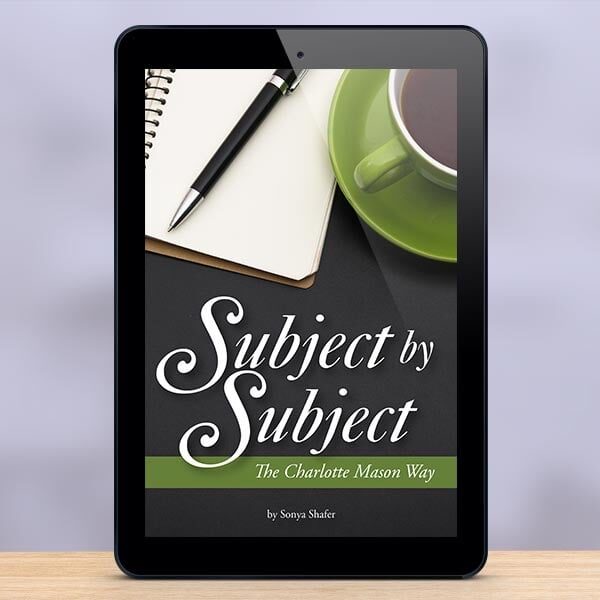
Get up to speed quickly with this free e-book and audiobook. Soon your family will be enjoying simple yet effective methods that spark lifelong learning!