child learning to read with letter blocksI well remember trembling when, as a young homeschooling mom, I realized that it was up to me to teach my child to read. My imaginative mind started racing down the path of worst case scenarios. As if on cue, a little voice message started playing in my head over and over, “If you mess up, she’ll never be able to read.”

Now, fifteen years later, I shake my head at the memory of that panic-stricken thought and gently chide myself for getting uptight over something that doesn’t have to be all that difficult. Yes, all four of my children have learned to read, and in all four cases (even my youngest with autism and developmental delays) I just had to get them started and they did the rest when they were ready. [Continue reading Alphabet Fun: Teaching Reading, part 1 …]

Boy with letter blocksLast week we talked about how to introduce the alphabet to your child through fun, informal play activities. Once your child knows his alphabet and the sounds the letters make, you can begin to put those sounds together to make short words. Two things to keep in mind at this stage. First, remember to keep these activities informal, and second, focus on words that mean something to your child.

Think about the way your child learned to understand the spoken word. He saw the ball, for example, and heard the sound-sign that represents it, “ball.” Pretty soon his little brain automatically associated the object with its sound-sign. Use the same strategy for this pre-reading stage. Introduce the word-signs that go with familiar objects and your child will find it easier to learn them. Here’s how. [Continue reading Pre-Reading Activities: Teaching Reading, part 2 …]

Homeschool girl with letter blocksUp to this point in our series on teaching your child to read, we have been talking about informal play activities. Once your child can read several dozen words from those activities, it’s time to start actual reading lessons. Charlotte advocated starting when the child was six years old but acknowledged that each child is unique. The key is not to hurry. Don’t push. Relax. Take your time. Wait until your child is ready. (Does this sound familiar?)

These reading lessons will also work well if you have been using a different reading curriculum and have gotten your child to a point where he can read short words and sentences but is having trouble making the transition to reading in a book. [Continue reading Sight Words and Sentences: Teaching Reading, part 3 …]

homeschool boy spells play with letter blocksAs you learned last time, Charlotte Mason’s reading lessons used two approaches: sight words and word-building. To add variety and keep things interesting for the student, Charlotte alternated lessons between the two. Last week we described how to do a sight-word lesson. This week let’s take a look at a word-building lesson.

Word-Building

Word-building lessons are a great tool to help your child learn to break words down into their smaller components. These type of lessons are also a wonderful opportunity to let your child discover that not every word with the same letter combination will be pronounced in the same way. Yet all of this is done in an interesting and gentle way. Here’s how. [Continue reading Word-Building and Phonics: Teaching Reading, part 4 …]

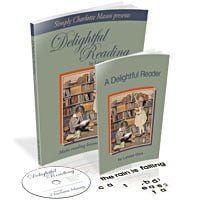
Delightful Reading kitSeveral months ago we received a note from a homeschool mom who was teaching her son how to read using Charlotte Mason’s method. (If you’re just joining this discussion, you can read our articles about Charlotte’s method of teaching reading.)

This mom had pulled together some wonderfully rich reading selections and seemed to have a solid grasp of how Charlotte taught reading. We so enjoyed reading through her lesson plans, nodding our heads at her helpful ideas, and smiling at her inventive extra sentences! [Continue reading Delightful Reading: A Charlotte Mason Reading Curriculum …]

Copyright © 2005–2013 Simply Charlotte Mason