
Free shipping on USA orders over $129!

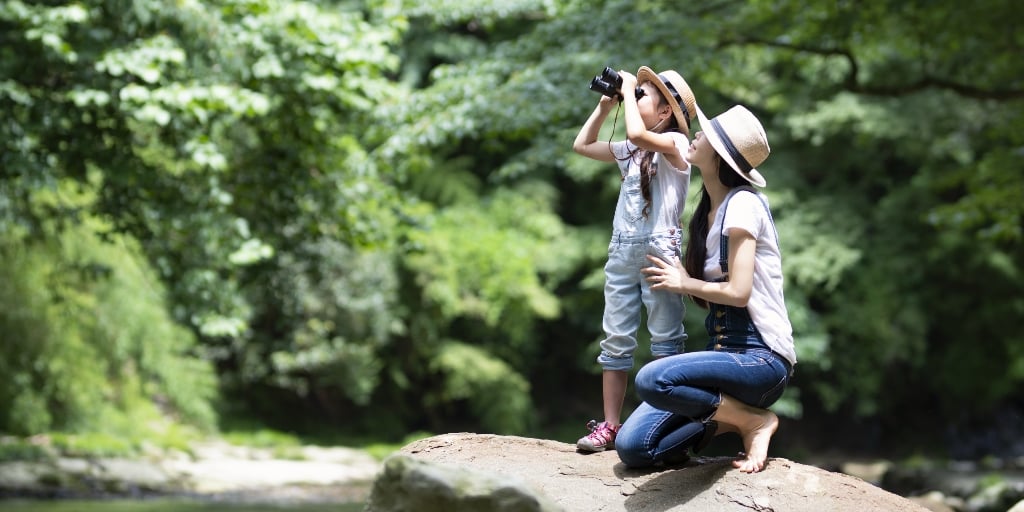
As we wrap up our series on nature study, I thought you might enjoy a highlights list of do’s and don’ts from Charlotte’s counsel to parents. Some of these tidbits of wisdom we have already covered in the series, but there are a few others that may be new to you.
I’m not going to say that these ten items cover everything you need to know. You will find a much more comprehensive collection of Charlotte’s comments on nature study in the helpful book, Hours in the Out-of-Doors. But these are ten important do’s and don’ts that will get you going the right direction—whether you have preschoolers or high schoolers—and help you feel more confident as you guide your child in learning about nature.
- Do spend regular time outdoors, all year round, and encourage a spirit of investigation. Your younger children can’t really spend too much time outside, and your school-age children should get out there at least once a week.
“It is infinitely well worth the mother’s while to take some pains every day to secure, in the first place, that her children spend hours daily amongst rural and natural objects; and, in the second place, to infuse into them, or rather to cherish in them, the love of investigation” (Home Education, p. 71).
- Do encourage your child to try to figure out answers to his questions rather than expecting you to do all the reasoning for him. Older children might jot down their questions in their nature notebooks and then go on a hunt for the answers for themselves.
“He must be accustomed to ask why — Why does the wind blow? Why does the river flow? Why is a leaf-bud sticky? And do not hurry to answer his questions for him; let him think his difficulties out so far as his small experience will carry him” (Home Education, p. 264).
- When you choose to answer his questions, do try to make the answer living—not just facts from a textbook.
“Above all, when you come to the rescue, let it not be in the ‘cut and dried’ formula of some miserable little text-book; let him have all the insight available, and you will find that on many scientific questions the child may be brought at once to the level of modern thought” (Home Education, p. 264).
- Don’t overwhelm your child with too much scientific terminology too soon. If he doesn’t use correct terminology in his observations, that’s okay. Encourage personal observation and narration in his own words first. Terminology for those ideas can come in the regular course of science lessons.
“Do not embarrass him with too much scientific nomenclature. If he discover for himself (helped, perhaps, by a leading question or two), by comparing an oyster and his cat, that some animals have backbones and some have not, it is less important that he should learn the terms vertebrate and invertebrate than that he should class the animals he meets with according to this difference” (Home Education, p. 265).
- Do give direction, sympathy, encouragement, and help with experiments. Be the friendly guide, not the fountainhead of all knowledge, for the student.
“The teacher affords direction, sympathy in studies, a vivifying word here and there, help in the making of experiments, etc.” (A Philosophy of Education, p. 19).
- Do teach science through a combination of nature study in the field, living books (both general and focused), natural object lessons, and special nature projects. Make use of both random and structured studies.
“The only sound method of teaching science is to afford a due combination of field or laboratory work, with such literary comments and amplifications as the subject affords” (A Philosophy of Education, p. 223).
- Do remember that dabbling in random scientific information is not the same as learning careful observation and understanding. Nature study should cultivate the habit of looking closely and carefully with a mind-set of eagerness for what we can learn ourselves.
“We may not confound a glib knowledge of scientific text-books with the patient investigation carried on by ourselves of some one order of natural objects; and it is this sort of investigation, in one direction or another, that is due from each of us. We can only cover a mere inch of the field of Science, it is true; but the attitude of mind we get in our own little bit of work helps us to the understanding of what is being done elsewhere, and we no longer conduct ourselves in this world of wonders like a gaping rustic at a fair” (Ourselves, Book 2, p. 101).
- Don’t correct your child’s nature notebook; it is his own possession. Encourage him to make it a personal reflection of his growing relationship with God’s creation.
“The children keep a dated record of what they see in their nature note-books, which are left to their own management and are not corrected. These note-books are a source of pride and joy, and are freely illustrated by drawings (brushwork) of twig, flower, insect, etc.” (School Education, p. 236).
- Do share your child’s wonder and admiration for his nature discoveries. Your attitude and enthusiasm will set the tone.
“One of the secrets of the educator is to present nothing as stale knowledge, but to put himself in the position of the child, and wonder and admire with him” (Home Education, p. 54).
- Do keep learning about science and nature yourself so you will have information to give your child as he desires it. Keep growing in your own relationship with nature.
“The mother cannot devote herself too much to this kind of reading, not only that she may read tit-bits to her children about matters they have come across, but that she may be able to answer their queries and direct their observation” (Home Education, pp. 64, 65).
You never know where time in nature might lead.
A little boy named Alan was told by his father, “Keep out of doors as much as you can, and see all you can of nature; she has the most wonderful exhibition, always open and always free.”
Alan did, starting in the garden of his own family’s home, then branching out farther and farther into a nearby forest. Those hours in nature, combined with the innocent childhood adventures he experienced outdoors, eventually became the setting for the beloved adventures of Winnie-the-Pooh.
Alan was A. A. Milne.
You never know where time in nature might lead.
Podcast: Play in new window | Download