
Free shipping on USA orders over $129!

“Where do I find a nature notebook?”
“What does it look like?”
“How do we go about creating a nature notebook? Is there a template somewhere?”
Questions like these cross my desk regularly. So let’s reveal the secret of the mysterious nature notebook. The secret is: it’s empty. That’s right. When you first get a nature notebook, it will be empty. A nature notebook is simply a blank notebook with stiff covers and heavy paper for writing, drawing, and painting. A sketchbook works well.
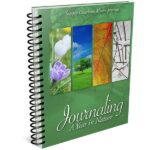
If you need some guidance or ideas of what kinds of things to look for during each season, you will find weekly prompts in Journaling a Year in Nature. That nature notebook is not completely blank, but it gives you lots of room to record your findings in writing and in illustrations, and that’s the key. Stiff covers, heavy paper, and lots of space.
Give each child his or her own nature notebook, and get one for yourself too. Susan Schaeffer Macaulay put it this way:
“If possible, it is good for the teacher (or parent) to keep a nature notebook, too; it is a life we live together” (For the Children’s Sake, Susan Schaeffer Macaulay, p. 135).
Then whenever you go outside to do nature study, make an entry or two in your notebooks. One mom I know got personal little satchels that are just the right size to hold a nature journal and some colored pencils or a small, portable watercolor paint kit. Each child can wear his satchel cross-body style, hands free, as he explores, yet keep his nature notebook close at his fingertips for whenever he sees something he wants to record.
What does he record? Charlotte Mason explained:
“As soon as he is able to keep it himself, a nature-diary is a source of delight to a child. Every day’s walk gives him something to enter: three squirrels in a larch tree, a jay flying across such a field, a caterpillar climbing up a nettle, a snail eating a cabbage leaf, a spider dropping suddenly to the ground, where he found ground ivy, how it was growing and what plants were growing with it, how bindweed or ivy manages to climb” (Home Education, p. 54).
Record in your nature notebook
- the date,
- what you see,
- where you see it, and
- any other observations from nature. Then
- embellish your notes with illustrations. And
- add appropriate poetry or quotations or Scripture, as desired.
Charlotte’s students also kept a running list of birds and flowers they saw throughout the year.
Older, more experienced students can include data for any personal nature experiments they want to perform and observe.
In other words, make the notebook your own. Each child can enter whatever he prefers; they don’t all have to be the same. In fact, each nature notebook will be different — and that’s okay.
These notebooks are designed to help cultivate within your child the joy of nature and discovery, not to become a source of irritation, frustration, or competition. If your child finds writing difficult, offer to write his comments in his notebook as he dictates them. And whatever you do, don’t grade or correct a nature notebook!
“The children keep a dated record of what they see in their nature note-books, which are left to their own management and are not corrected. These note-books are a source of pride and joy, and are freely illustrated by drawings (brushwork) of twig, flower, insect, etc.” (School Education, p. 236).
If you would like to see a sample of a beautiful nature notebook, take a look at The Country Diary of an Edwardian Lady by Edith Holden. This book is a replica of a 1906 nature notebook that contains dated entries, detailed illustrations, and selected poetry and quotes. A word to the wise: look at it for inspiration, not for comparison. Edith was an art student, and it shows in her exquisite paintings. If looking at her entries makes you or your child feel inadequate, put it away!
You might also enjoy Clare Walker Leslie’s books on nature journaling. Her Keeping a Nature Journal does a fabulous job of taking any perceived pressure off the process and encouraging you to pour your own personality into your notebook. Her pages look entirely different from Edith Holden’s, and that’s as it should be; they are two entirely different naturalists.
And so are you and your children. Your nature notebooks will become “a source of pride and joy” as you each, one entry at a time, transform your blank journal into a personal reflection of your own nature experiences and growing interest in God’s creation around you.
Next time we’ll talk about how to pair nature study with its other half: living science books.
Podcast: Play in new window | Download
I provide my kids with colored pencils instead of paints. They are less messy and easier to pack for a day at the park. They are also perfect for little ones who may not have the necessary fine motor skills for painting.
Hi! This is from my recent blog post on nature study. I thought it might be appropriate to share:
The only thing I require of the child is to write the Latin names of the species if at all possible. I avoid at all cost being critical of the sketches or the recorded observations. All I have to say is that the Creator made everything thoughtfully, and with that in mind, we should also examine things regardfully, and write carefully about them. There is no need for chatter, for a sketch speaks a thousand words. With my oldest daughter, words are hand-picked to tell the stories.
Thanks for the great tips. My twin boys will be five years old soon and I want to give them each nature journals in the spring. They are just starting to show an interest in drawing and I think they will absolutely love having their own notebooks to draw in.
Love this! A couple of questions come to mind- I have heard a lot about dry brush painting- how essential is it to use that versus colored pencils? Also, what do you find is the best size of sketch book for a child to use?
You can use dry brush painting, but I would recommend it only if you and your child have experience with it outside of the nature notebook first. In other words, don’t use the nature notebook as a lesson in painting. The main thing is that you want to use a drawing/writing instrument and technique that the child is very comfortable with, so the instrument will become invisible and he can focus on the nature rather than the effort of drawing or painting.
As to the size of sketch book, that depends on the child. Young children have smaller hands, so one would think that a smaller book would be easier for them to hold; yet many young child need lots of paper-space when trying to write or draw, so a larger book with larger pages may be more user-friendly. If a larger book would work better for your child’s writing and drawing skills right now, you might try getting a cross-body bag that will make it easier for him to carry the sketchbook while in the field.
Most naturalists use a variety of media and a variety of notebook sizes. All of that can be customized to be a reflection of the person’s preferences. The main thing is to get out there and form those relations with nature.
Thank you so much for that clarification! I’ve been avoiding nature study, feeling that I have to do it a certain way -and not knowing how to do it. This frees me up to attempt it again with media I am more comfortable with.
I have provided my boys with nature journals and yet the choose not to use them. They are accessable, I module indiviually placing an entry when inspired, I encourage them to place their finds in the book and yet they don’t touch them! Any advice? Ages 9, 7, 5
A couple of ideas come to mind, Rebecca. The boys evidently have not yet formed the habit of using their notebooks, so feel free to require that they record something every week when you do your nature study together, not just when they are inspired to. You don’t want to criticize or critique their drawing or spelling or any specific skills, but you can absolutely make regular entries in their journals an assignment, with the goal that it will become a habit.
The second idea is that it sounds like the boys might profit from a bit of direction outside. It might be helpful if you go out there with a specific objective in mind: “today we’re going to look for spider webs and see if we can find any spiders at home” or “this week we’re going to go check on our oak tree and see what is happening with it during this season.” Now, of course, you can look at other things and should always be open to other nature friends that come across your path, but having that one focus in mind may help get the ball rolling.
Once they get the habit of drawing or writing something in their notebooks every week and have a specific goal to get them started with that assignment, they may find it easier to start to expand on those practices. Keep modeling what you would like their relationship with nature to become and give them a little more direction along the way.